
CORE-DRILLES BOLLARD INSTALLATIONS
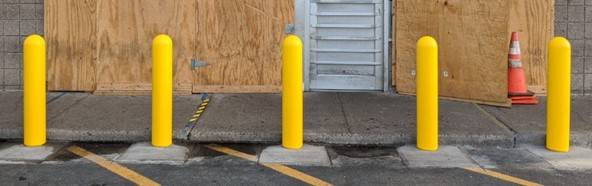
Disclaimer
ALL Readers: The purpose of this page is to give a rough overview of some basic bollard barrier systems.
Our Definitions: We have come up with many of these definitions for our own purposes. They are not necessarily definitions that are used by others in the industry.
For In-Ground or Core-Drilled Bollard Pipe Installations
➡️ Request a Quote Today
Steel pipe bollards are available in multiple sizes and wall thicknesses to suit every application.
The most common model for parking lots and commercial installations is the 6 5/8″ Schedule 40 / 80 / 120 / HHX steel bollard.
Depending on your project requirements, other diameters may be more suitable:
📌 Light to Medium-Duty Protection
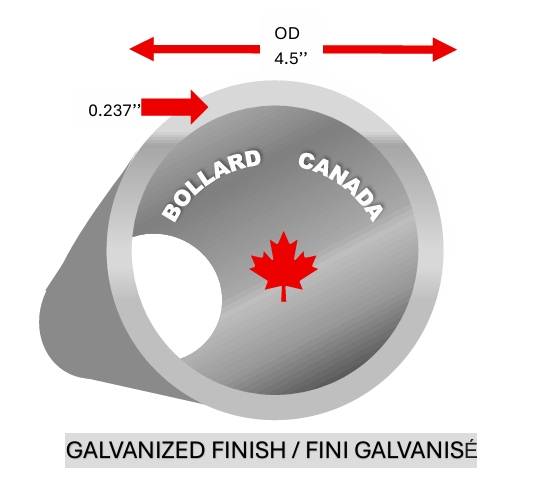
4 1/2″
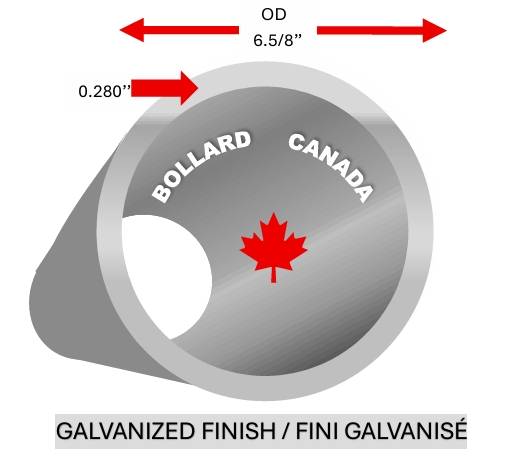
6 5/8″
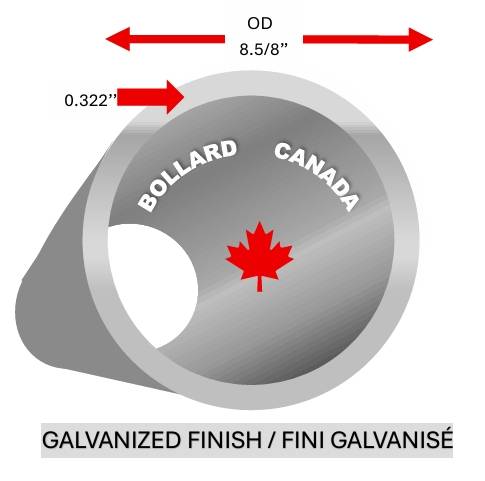
8 5/8″
👉 Schedule 40 options — ideal for general traffic & visual protection
📌 High-Strength & Compact Impact Protection
4 1/2″
6 5/8″
8 5/8″
👉 Schedule 80 / 120 / HHX — thicker walls for increased resistance & industrial use
📌 Heavy-Duty Anti-Ram & Barrier Protection
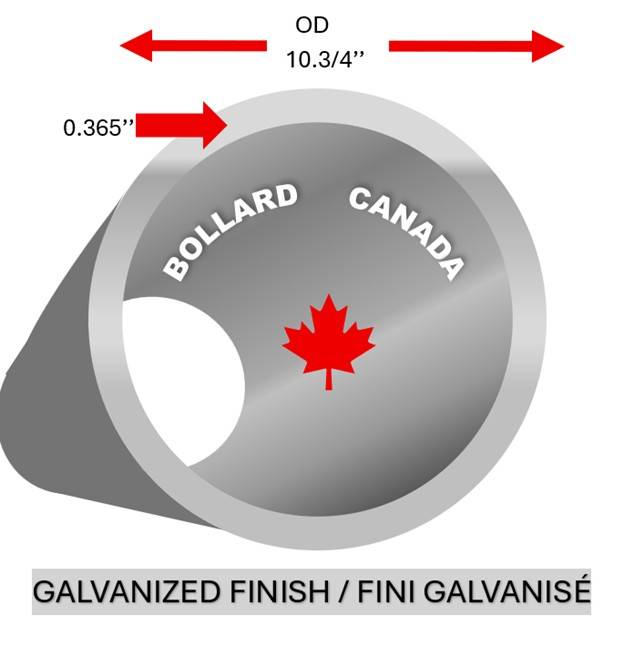
10″ Schedule 40 / 120 / XXH
12″ Standard Wall Pipe
👉 Used for high-security zones, entrances, building perimeters, public infrastructure & impact zones
These bollards are designed for in-ground concrete installation, typically core-drilled or set in excavation, then filled with concrete (optional depending on application) to ensure structural stability and long-term perimeter protection.
Surface-Mounted Alternatives
When excavation is not possible or not required, Bollard Canada offers:
Surface-Mounted Safety Posts
Bolt-Down Protection Posts
Base Plate Bollards (on request)
Installed directly on concrete using anchors, these are ideal for:
✔ warehouses & logistics facilities
✔ storefront security
✔ parking garages
✔ projects where ground penetration is not feasible
⚠️ Important Notice — Performance Difference
Bolt-down or surface-mounted bollards are not as strong or impact-resistant as in-ground or core-drilled installations.
Surface-mounted systems are intended for light-duty applications, visual guidance and non-structural protection and
should not be considered a substitute for embedded security bollards where actual impact resistance or vehicle mitigation is required.
In-ground / core-drilled bollards provide superior structural performance, force resistance, and long-term durability.
Why Choose Bollard Canada Inc.?
✔ Large inventory → Fast shipping across Canada (1–3 days)
✔ Designed for Canadian climates (snow, salt, corrosion, impact)
✔ Competitive pricing + volume discounts
✔ Custom fabrication available — sizes, heights, colors, logos, and HDPE covers
✔ Expert assistance to select the right bollard for your application
Get a Competitive Quote
Let us quote your bollard project — no obligation.
If we’re not the right fit, we will gladly point you in the right direction to make sure you get what you need.
📧 info@bollardcanada.com
📞 1-800-791-0163
How Much Concrete Is Required to Install a Bollard?
When installing a steel bollard, it is important to calculate not only the concrete around the post, but also the concrete required to fill the inside of the bollard.
A commonly used field guideline is to install bollards at a minimum depth of 4 feet, with a footing diameter of at least three times the diameter of the bollard. This method provides greater stability and improved resistance to impact.
In this article, we calculate the amount of concrete required for three common bollard sizes:
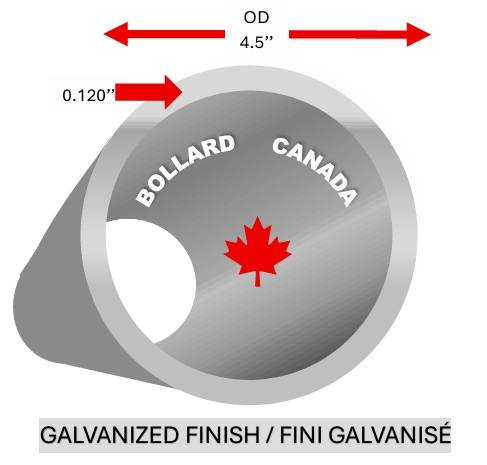
- 4.5-inch diameter bollard
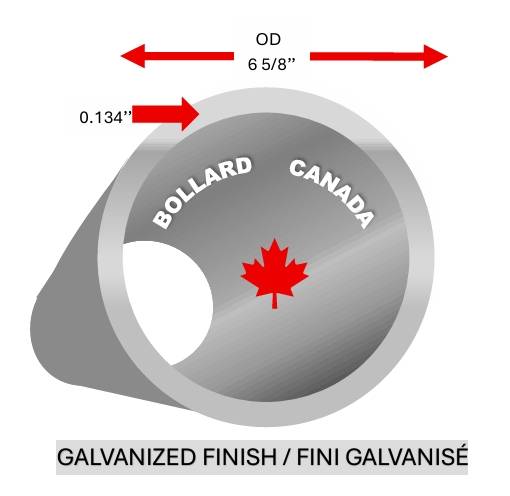
- 6 5/8-inch diameter bollard
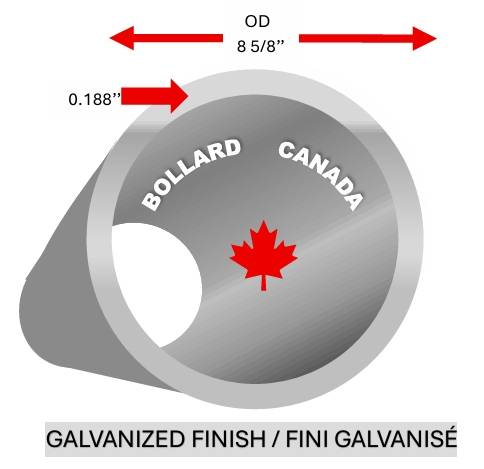
- 8 5/8-inch diameter bollard
All calculations are based on:
- Installation depth: 4 feet (48 inches)
- Hole diameter: 3 times the bollard diameter
- Bollard interior filled with concrete
- Standard steel pipe dimensions (typical Schedule 40 reference)
Calculation Method
The total concrete required includes two components:
1) Concrete around the bollard
This is the volume of the cylindrical hole minus the outside volume of the steel post.
2) Concrete inside the bollard
This is the internal volume of the pipe filled with concrete to the full depth of installation.
1) 4.5" Diameter Bollard
Installation Dimensions
- Bollard diameter: 4.5 inches
- Hole diameter (3× rule): 13.5 inches
- Depth: 48 inches
Concrete Required
Concrete around bollard:
3.53 cubic feet
Concrete inside bollard:
0.35 cubic feet
Total Concrete Required
3.89 cubic feet
Equivalent to approximately:
- 0.144 cubic yards
- 110 liters
Number of Bags Required
- 7 bags of 30 kg (66 lb)
- 8 bags of 25 kg (55 lb)
2) 6 5/8" Diameter Bollard
Installation Dimensions
- Bollard diameter: 6.625 inches
- Hole diameter (3× rule): 19.875 inches
- Depth: 48 inches
Concrete Required
Concrete around bollard:
7.66 cubic feet
Concrete inside bollard:
0.80 cubic feet
Total Concrete Required
8.46 cubic feet
Equivalent to approximately:
- 0.313 cubic yards
- 240 liters
Number of Bags Required
- 15 bags of 30 kg (66 lb)
- 17 bags of 25 kg (55 lb)
3) 8 5/8" Diameter Bollard
Installation Dimensions
- Bollard diameter: 8.625 inches
- Hole diameter (3× rule): 25.875 inches
- Depth: 48 inches
Concrete Required
Concrete around bollard:
12.98 cubic feet
Concrete inside bollard:
1.39 cubic feet
Total Concrete Required
14.37 cubic feet
Equivalent to approximately:
- 0.532 cubic yards
- 407 liters
Number of Bags Required
- 24 bags of 30 kg (66 lb)
- 29 bags of 25 kg (55 lb)
Summary Table — Concrete and Bags Required
| Bollard Diameter | Hole Diameter (3×) | Depth | Total Concrete | 30 kg Bags | 25 kg Bags |
|---|---|---|---|---|---|
| 4.5" | 13.5" | 48" | 3.89 ft³ | 7 | 8 |
| 6 5/8" | 19.875" | 48" | 8.46 ft³ | 15 | 17 |
| 8 5/8" | 25.875" | 48" | 14.37 ft³ | 24 | 29 |
Why Proper Concrete Volume Matters
Using the correct amount of concrete is critical for:
- Structural stability
- Long-term durability
- Impact resistance
- Compliance with installation best practices
Underestimating concrete volume can weaken the installation and reduce the effectiveness of the bollard.
Professional Installation Tip
On real job sites, it is recommended to plan for one additional bag of concrete per bollard to account for:
- Uneven hole dimensions
- Soil conditions
- Minor concrete loss during placement